

What is Job Rotation?
Job Rotation is a structured human resource and talent management practice where employees are systematically moved across different roles, tasks, or departments within an organization. The purpose is not just to fill temporary gaps but to create a dynamic learning environment that strengthens employee skills, builds organizational resilience, and prepares future leaders. When applied effectively, it fosters adaptability, breaks down silos, and encourages innovation by exposing employees to different perspectives.
Through rotation, employees gain a deeper understanding of the organization’s overall operations, culture, and strategy, while managers benefit from having a more flexible, motivated, and cross-trained workforce. Unlike simple task-switching, job rotation is intentional, planned, and aligned with both employee career paths and organizational goals.
Main Components
The 8 Main Components of Job Rotation
Job Rotation is not a one-dimensional concept but a practice that rests on several interdependent components. Each of these components contributes to making rotation effective for both employees and the organization. On the one hand, employees experience growth, engagement, and career advancement by being exposed to diverse tasks and environments. On the other, organizations benefit from building flexibility, reducing operational risks, and strengthening cultural cohesion.
These components provide a framework that ensures job rotation is purposeful, structured, and aligned with strategic goals rather than simply moving people around for convenience. By understanding these eight main components, leaders and HR professionals can design rotation programs that balance employee aspirations with organizational needs, creating long-term value for all stakeholders.
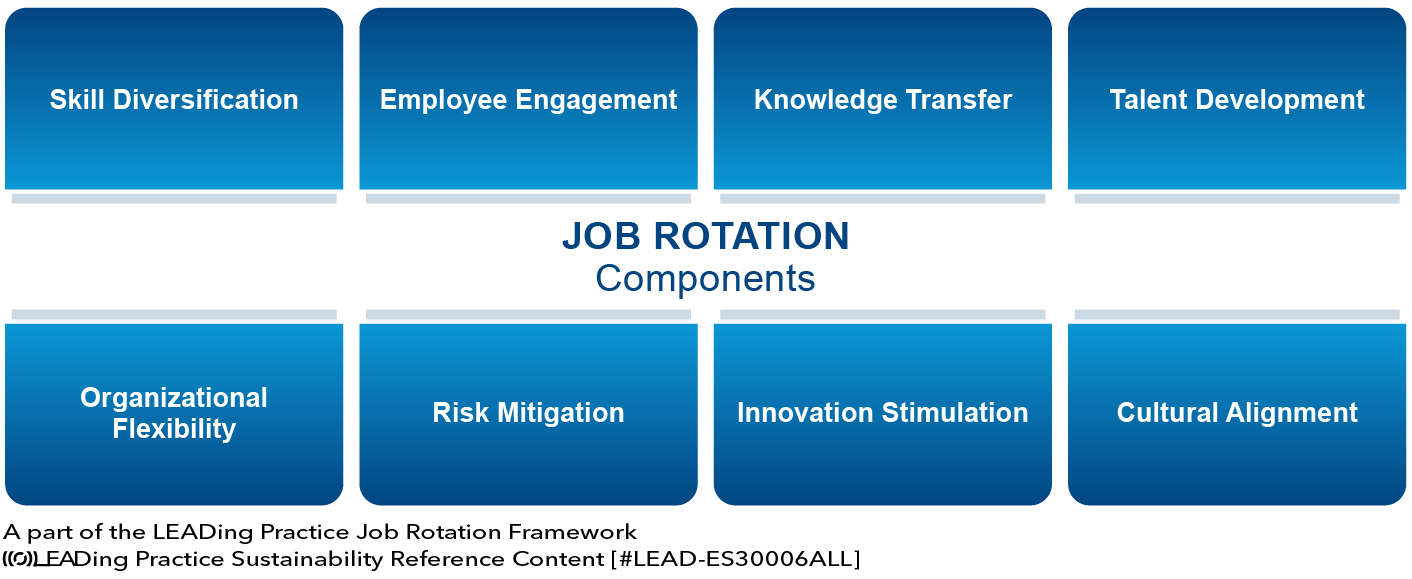
Below are the eight main components of Job Rotation, reflecting both structural patterns and actionable insights for organizations:
The eight main components of Job Rotation form the foundation of any effective rotation program. They capture how rotation can simultaneously enhance employee skills, transfer knowledge, and nurture future leaders while strengthening organizational adaptability and culture. When organizations approach job rotation with a clear understanding of these components, they avoid treating it as an administrative exercise and instead embrace it as a strategic tool.
Together, these elements illustrate that job rotation is not only about moving employees but also about creating a cycle of continuous learning, innovation, and sustainability within the workplace. By embedding these components into their talent strategies, organizations are better positioned to thrive in a competitive and constantly evolving environment.
Why This Is Relevant
Why is Job Rotation so Relevant?
In today’s fast-changing business environment, organizations need employees who are adaptable, motivated, and skilled across different functions. Job Rotation directly addresses this need by creating a workforce that is flexible, resilient, and continuously learning. The relevance of Job Rotation lies in its ability to connect individual career development with broader organizational goals. For employees, it reduces monotony, expands career opportunities, and provides meaningful learning experiences.
For organizations, it ensures knowledge continuity, strengthens leadership pipelines, and enhances the ability to respond quickly to change. In industries facing disruption, digital transformation, or sustainability challenges, job rotation becomes a strategic lever to build a future-ready workforce. Its importance goes beyond HR—it is a driver of organizational agility, innovation, and long-term competitiveness.
Business/Value Case
The Business/Value Case for Job Rotation
Job Rotation is not just an HR initiative; it delivers measurable business value across the organization. By rotating employees into new roles, companies create a culture of adaptability and learning while ensuring that knowledge is shared and retained. The business case for Job Rotation lies in its ability to strengthen organizational agility, boost engagement, and develop versatile leaders.
It prepares employees for long-term career growth while protecting organizations from risks such as turnover or market disruption. This dual value—enhancing both employee satisfaction and business resilience—makes job rotation one of the most relevant and sustainable talent development practices.
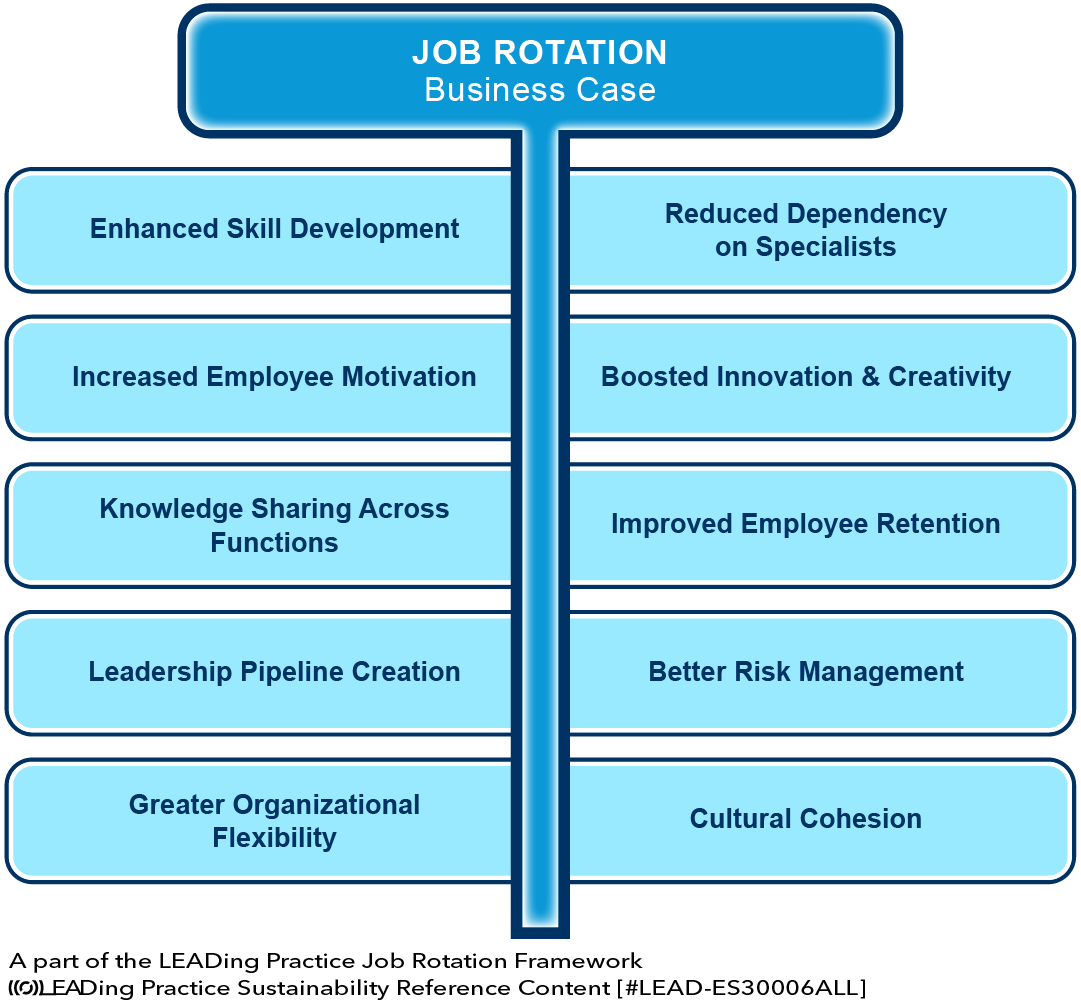
Below are ten key benefits that highlight why this approach is essential for modern organizations:
The relevance of Job Rotation lies in its ability to bridge the gap between individual career growth and organizational adaptability. In an era of constant change, businesses cannot rely solely on static roles or narrowly specialized employees. Job rotation builds resilience by equipping staff with diverse experiences and perspectives, ensuring organizations can adapt quickly to disruption, technological shifts, or new market demands.
For employees, it creates purposeful career journeys, prevents disengagement, and strengthens their connection to the company’s mission. For organizations, it reduces risk, fosters innovation, and develops future leaders who understand the business from multiple angles. This dual benefit makes job rotation not just relevant but essential for organizations that aspire to remain competitive, sustainable, and future-ready.
How-To-Guide
How-To-Guide: The Job Rotation Framework
Job Rotation works best when it is not improvised but embedded into a structured framework. The Job Rotation Framework provides organizations with a roadmap for planning, executing, and monitoring rotation programs that align with the business strategy. At its core, the framework combines the Job Rotation Business Case—the rationale for why the organization should adopt it—with a 10-step execution plan. By standardizing processes, clearly defining responsibilities, and ensuring alignment with both organizational and employee goals, the framework creates clarity, transparency, and efficiency.
Employees benefit from guided development journeys, managers gain flexible team members, and the organization builds resilience and leadership capacity. A framework ensures that job rotation is not ad hoc but a consistent, scalable practice that delivers long-term value for all stakeholders involved.

The 10-Step Way Forward:
The Job Rotation Framework transforms job rotation from a loose practice into a structured system. By following the 10-step approach—assessing needs, defining scope, piloting, monitoring, and scaling—organizations ensure consistent and measurable results.
This framework not only accelerates employee development but also embeds resilience, flexibility, and innovation into the organization. With clarity of roles and processes, businesses can launch job rotation initiatives effectively and with confidence.
Contact Us
Wanna learn more ? Want to improve your company ?
Projects that require our help ?
Don't waste more time, contact us !
Most Common Pitfalls
The Most Common Pitfalls and Challenges
Job Rotation delivers strong value when implemented correctly, but poorly executed programs often create more problems than benefits. Organizations sometimes underestimate the resources required, fail to align with business goals, or overlook employee readiness. These pitfalls can result in disengagement, productivity loss, or resistance from both managers and employees.
To avoid setbacks, it is crucial to recognize the antipatterns (ineffective approaches repeated in practice) and worst practices (serious missteps that damage outcomes) that undermine rotation programs. By being aware of these challenges in advance, leaders can take preventive action and set their job rotation initiatives up for success.

5 Antipattern Examples
- Unclear Objectives: Rotations launched without clear learning or business goals confuse participants and reduce program impact.
- One-Size-Fits-All: Applying identical rotations to all employees ignores individual development needs and career paths.
- Lack of Feedback Loops: No mechanism for employee or manager feedback limits learning and weakens program effectiveness.
- Short-Term Focus: Viewing rotation only as temporary coverage instead of long-term talent development diminishes its strategic value.
- Ignoring Employee Readiness: Placing employees into roles without assessing skills or interests causes frustration and lower performance.

5 Worst Practice Examples
- Neglecting Training and Support: Failing to provide onboarding and mentoring during rotations leaves employees unprepared and sets them up for failure.
- Poor Communication: Not explaining the purpose, process, and benefits leads to resistance from employees and managers.
- Overloading Employees: Assigning rotations on top of full workloads creates stress, burnout, and disengagement.
- Misaligned Timing: Placing rotations during peak operational periods disrupts business continuity and frustrates teams.
- No Measurement of Outcomes: Ignoring KPIs or success metrics prevents organizations from evaluating program effectiveness or making improvements.
Lessons Learned
Learning from the Outperformers: Lessons Learned
Organizations that excel at Job Rotation demonstrate how structured programs can deliver both business and employee value. These outperformers treat job rotation not as an HR formality but as a strategic tool for growth, innovation, and resilience. By aligning rotation with long-term goals, embedding learning mechanisms, and fostering cultural buy-in, they maximize impact.
From their approaches, we can extract a set of best practices (proven methods that work well) and leading practices (innovative approaches that push beyond standard methods). Together, these offer practical guidance for organizations aiming to elevate their job rotation initiatives.
5 Best Practice Examples
- Align with Strategy: Job rotations are linked directly to organizational goals, ensuring relevance and measurable impact.
- Structured Planning: Programs follow a clear timeline with predefined objectives, participant criteria, and evaluation methods.
- Supportive Learning Environment: Employees receive coaching, mentoring, and training to succeed in new roles.
- Transparent Communication: Organizations explain the purpose and benefits of rotation to secure employee and manager commitment.
- Performance Evaluation: Rotations include feedback and assessments to track development and business outcomes.

5 Leading Practice Examples
- Personalized Career Mapping: Rotation paths are customized to match employee aspirations and organizational talent needs.
- Cross-Border or Cross-Industry Rotations: Employees rotate across countries, divisions, or even industries to broaden global and market perspectives.
- Integration with Succession Planning: Rotation is embedded into leadership pipelines, ensuring future leaders have wide exposure.
- Digital Job Rotation Platforms: Technology is used to match employees with rotation opportunities, track progress, and measure ROI in real time.
- Sustainability-Oriented Rotations: Employees are placed in roles focused on sustainability initiatives, aligning development with long-term organizational responsibility.
Most Common Artefacts
The Most Common Artefacts
When organizations implement Job Rotation, success depends on more than good intentions or informal practices. To be effective, rotation must be supported by well-defined artefacts—practical tools, frameworks, and documents that structure the process and ensure alignment with both employee development and organizational goals. Artefacts provide the foundation for consistency, transparency, and measurement.
They guide HR teams and managers in planning, help employees understand expectations and learning objectives, and enable leadership to track progress and business impact. Without such tools, job rotation risks becoming disorganized, unfair, or ineffective. By integrating the right artefacts, organizations transform rotation into a reliable, repeatable practice that strengthens sustainability, innovation, and talent pipelines.
| Artefact | Description | How it Can Be Used for Sustainability Innovation |
|---|---|---|
| Job Rotation Policy Document | Defines scope, rules, duration, and eligibility for rotation programs. | Ensures transparency and consistency, creating a fair system that supports long-term talent sustainability. |
| Rotation Schedule/Plan | Outlines the timeline, sequence of roles, and rotation cycles. | Provides structure and predictability, helping employees and managers prepare for transitions. |
| Competency Matrix | Maps required skills across roles and tracks employee capabilities. | Identifies gaps, supports targeted learning, and aligns development with business needs. |
| Learning and Development (L&D) Plan | Details training, mentoring, and support during rotations. | Ensures employees gain the necessary skills and confidence in each new role. |
| Feedback and Evaluation Forms | Collects structured input from employees, managers, and peers. | Measures effectiveness, uncovers challenges, and informs improvements. |
| Job Rotation Logbook/Journal | Employees record experiences, learnings, and reflections. | Builds personal accountability, supports continuous learning, and creates organizational knowledge assets. |
| Progress Dashboards | Visual tools to track participation rates, skills gained, and program outcomes. | Enables HR and leadership to monitor impact and adjust programs strategically. |
| Succession Planning Map | Links rotation experiences to long-term leadership and career development paths. | Ensures rotation feeds into sustainable pipelines for future leaders. |
Overview of the most common artefacts used with Job Rotation.
The use of artefacts in Job Rotation ensures that the program is not only well-designed but also sustainable over time. Tools such as policies, schedules, competency matrices, and evaluation mechanisms make it possible to align career development with strategic business needs, while dashboards and succession maps help track long-term outcomes. These artefacts bring clarity, fairness, and accountability, ensuring that employees feel supported and organizations capture real value from the initiative.
By embedding such artefacts into their talent management frameworks, companies can transform job rotation from a loose idea into a structured, measurable, and future-oriented practice. Ultimately, artefacts are the bridge that turns job rotation into a driver of both employee growth and organizational resilience.
Conclusion
Job Rotation is far more than a temporary staffing approach; it is a strategic method for developing talent, driving engagement, and strengthening organizational resilience. By moving employees across roles and departments, organizations foster skill diversity, enhance knowledge transfer, and prepare a workforce that is adaptable to change. The framework, artefacts, and lessons from outperformers show that when job rotation is planned and supported, it delivers measurable benefits for both employees and the business.
The key lies in aligning rotation with organizational goals, supporting participants with training and feedback, and embedding the practice into long-term talent and leadership strategies. When done well, Job Rotation is a catalyst for innovation, cultural cohesion, and sustainable growth—making it an essential tool for organizations aiming to thrive in today’s evolving business landscape.